
Written by Braydon Walker
The dream
“Some people still ‘fall over backwards’ with shock when I tell them I am a teacher.”
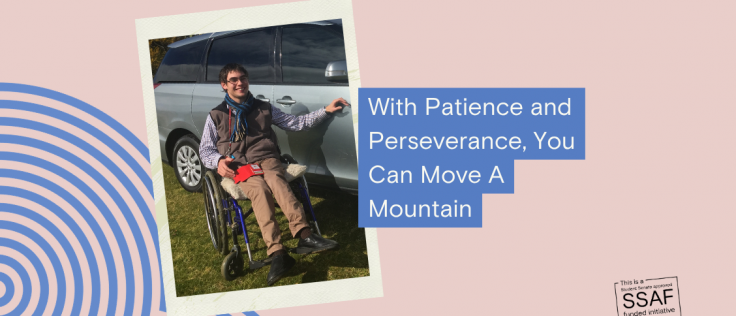
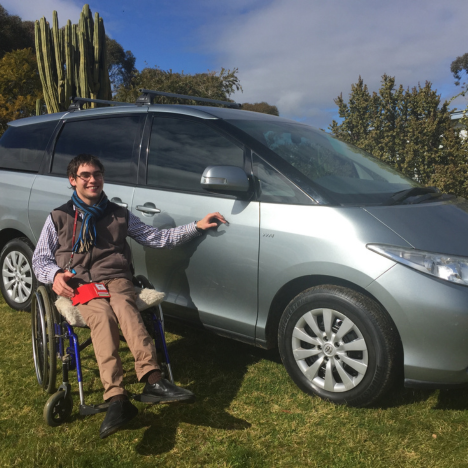
I grew up in Young, NSW. I have always wanted to become a teacher. However, having Cerebral Palsy and having to use a manual wheelchair to be mobile, I was not sure how or if the dream of becoming a teacher would even work out.
When I graduated high school in 2012, I had accepted an Early Entry offer into Charles Sturt University in Wagga Wagga. I have always wanted to study teaching. You know when you have that ‘one’ teacher that inspires you to do something, well that was me. Growing up with a disability, I was already familiar with my physical limitations; I knew that I could achieve my dream. The physical side of things was not the problem. Nowadays there are so many technological advancements that I was not worried about whether I was able to physically do the job. Accessibility is a concern, schools should be accessible, with electronic boards, ramps and lifts to access most areas. The challenge was more mental and overcoming my own doubts.
Another challenge I faced was dealing with the doubts of people and the stigma around working with a disability. Some people still ‘fall over backwards’ with shock when I tell them I am a teacher. However, these reactions from people are part of what gave me the motivation and drive to complete my degree and teach. I wanted to demonstrate to people that you can live a good fulfilling life with purpose and work. I wanted to help raise awareness for people with or without a disability, that working with a disability is possible. Working full-time may not be an option due to fatigue and that’s ok.
Starting uni
I booked campus tours of the accommodation and overall wheelchair access to ensure that it was suitable. I decided to move into the student accommodation on Wagga Wagga Campus to commence study in 2013. I first moved into Cottages, the accessible room and bathroom were very spacious, which made it easier for me to move around. The bathroom had plenty of grab rails too. I moved off campus in 2017 for a change, then moved back into Hamptons in 2022-2024. Hamptons I preferred as it is a more recent build. The accommodation team is very approachable and open to suggestions. For example, I was struggling to open the door to the building one day and someone noticed. Soon after that there was an automatic door put on the building. The only issue I had was when it was raining the automatic door would not work properly, which the accommodation team was open to fixing.
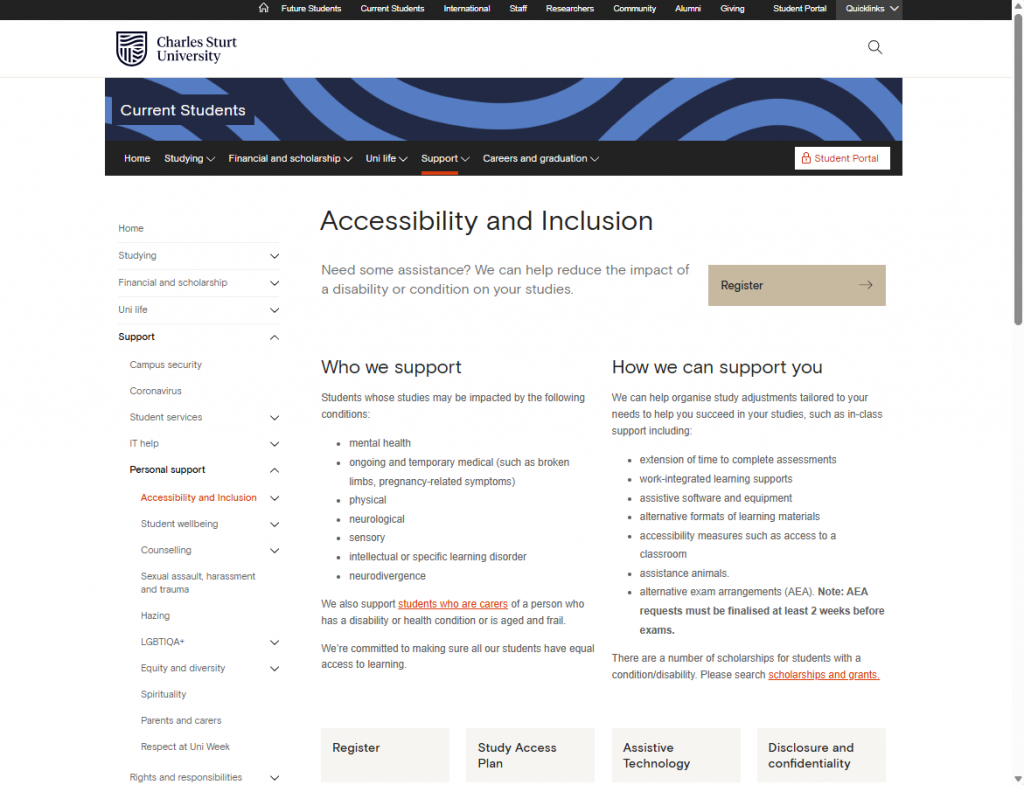
When I commenced study in 2013, it took me a while to find my study/life/disability balance. I attempted to start with a full load of 4 subjects, which I quickly found out was too much for me to handle, so I did three. Studying with a disability can be challenging, but it is achievable. I was able to contact the Accessibility and Inclusion team at Charles Sturt Wagga; we had a conversation around my needs and how the university could best support me during my studies. Part of the process involves the development of a Study Access Plan, which includes adjustments required to achieve your studies. You need to send this plan to your subject coordinators at the beginning of each semester; that way they are aware of the adjustments you may need. These things may include extra time for exams, extensions for assignments due to fatigue or access to assistive technology such as Dragon Naturally Speaking, which is a voice to text software. I found the software helpful when I was writing assignments, being able to dictate what I wanted to say, rather than typing. The software made the process of writing essays quicker, easier and less fatiguing.
Placements
When organising my placement, the Charles Sturt placement coordinator, Accessibility and Inclusion team and myself had a meeting to discuss my needs and the adjustments required to make the placement a success. It was suggested, which I agreed, to be organised as a three-day week, considering my fatigue levels. However, there was one week during that placement when I did trial five days. I found this to be too much, and that’s ok. Learning your own limitations is all part of the journey. Trial and error as they say. The Charles Sturt placement coordinator was very helpful and approachable when discussing issues of accessibility and/or possible technology I may require for the placements to run smoothly.
One of the things I found when I started doing teaching prac placements and working as a teacher is that workplaces are open to feedback. People would come and ask me for feedback on accessibility and ask how they might be able to improve it to make it easier for me to get around and do my job. Workplaces are often unaware of these things because they either have not employed someone with a disability or disabled people have not spoken up about the accessibility. For example, ramps at the appropriate gradient, not too steep, large enough disabled bathrooms that are in appropriate accessible places and wide enough doorways for wheelchairs so that we do not scrape our hands on doorways. These are just a few things, but do not be afraid to give your workplaces feedback to improve accessibility, especially if they ask, that is even better.
Don’t quit
No matter how long it takes for you to achieve your dream/goal, it is important to keep going, don’t quit if it’s what you want to do. If you quit, you will never find out what you can achieve, then you are just left with the ‘what ifs’.
- ‘What if I had kept going and was going to be successful in my field’?
- ‘What if I kept going and it did work out?’
Flip the script and ask yourself:
- ‘What if I am successful’?
- ‘What if I am able to achieve this goal?’
- ‘What if I encourage someone to overcome their adversity, if they are having the same doubts’?

To finish my study to become a fully qualified teacher took me 13 years. But hey, that’s ok. Sometimes you just have to ‘roll with it’, literally! Life happens; the hard stuff builds character and perseverance. Studying with a disability is challenging because you have extra life challenges you need to deal with daily. Fatigue, access issues, getting to class and factoring in the extra time it takes to do all the ‘normal’ daily tasks that people take for granted. But allowing yourself time to learn how to manage all the demands of uni along with your disability and life, is doable and rewarding. Yes, that may mean that completing your degree may take longer, but that’s ok. Everybody’s journey is different, I know it’s hard not to compare yourself to others that seem to be ahead of you. But they are not you. Enjoy where you are at in life and the journey to where you are going. Be patient. Persevere. You can do this!
Charlie blog is a SSAF initiative.