Written by Tess Ezzy
“Consent isn’t complicated—it’s respect, communication, confidence and connection.”
— Charles Sturt University

You’ve probably seen this line on Charles Sturt’s social media recently. It’s part of the university’s campaign to remind students what consent really means—and why it matters.
But for some of us, it’s not just a campaign.
It’s personal.
My Story (And Why I’m Telling It Now)
When I was seventeen, I thought I understood consent.
We were taught about it in school. A policeman came in and told us:
“Say no.” “Use a strong voice.” “Get help if something happens.”
But when it happened, I froze.
I was wearing my school uniform. He wore a suit. We were in a bathroom. He smelled like coffee and carried an umbrella.
There was no fight.
Just pressure.
Confusion.
Fear.
I said no.
I said stop.
I said, “You’re hurting me.”
But he didn’t stop.
Afterwards, he filmed me saying it was consensual.
Three takes—until I could say the words without crying.
So Where Does Cake Come In?

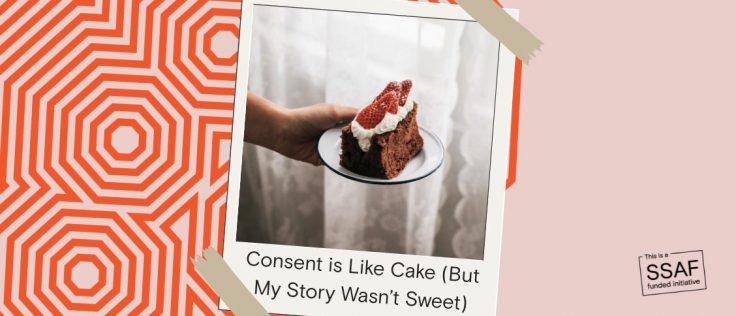
There’s a widely used analogy: consent is like offering someone cake.
You ask if they’d like some.
If they say yes—great.
If they say no—you respect that.
You don’t force-feed it. You don’t guilt them into it. You don’t offer it while they’re asleep.
And you definitely don’t assume silence means “sure, go ahead.”
Simple, right?
That’s why the cake analogy works.
It shows that we already understand consent in other parts of life. We just struggle when it involves sex, intimacy, or power.
Because real consent is more than “getting a yes.”
It’s about making sure that yes is safe, free, and enthusiastic.
What the Cake Analogy Leaves Out (But I Won’t)
What happened to me wasn’t a misunderstanding.
It wasn’t confusion or mixed signals.
It was coercion. It was disregard. It was harm.
And yet—I stayed silent.
Because I thought freezing meant I’d failed.
Because I thought saying no wasn’t enough.
Because he recorded me saying it was okay.
Because I didn’t want anyone to ask if I “led him on.”
Because I didn’t want to be looked at differently.
Because I was terrified.
But silence is not consent.
Freezing is not consent.
Crying while saying “yes” on camera is not consent.
What Consent Really Is

Here’s what real consent looks like (FRIES):
Freely given – No guilt, threats, or pressure
Reversible – You can say yes and then change your mind
Informed – You know what you’re agreeing to
Enthusiastic – A “yes” should sound like excitement, not obligation
Specific – Saying yes to one thing doesn’t mean yes to everything
For Anyone Who’s Been Hurt
If you’re reading this and you’ve experienced something similar, I want to tell you what I wish I’d been told:
- You are not to blame.
- You didn’t imagine it.
- You are allowed to freeze and still call it assault.
- You are allowed to be angry. To grieve. To heal.
- You don’t have to tell anyone—but if and when you do, your story matters.
Consent really is like cake: it should be offered, not taken. Enjoyed, not forced. Shared with joy, not fear. But unlike cake, consent is not optional.
And if your “no” wasn’t heard—or your silence was misused—that’s not on you. That’s on them and I’m sorry.
I’m speaking now because I couldn’t back then.
Because someone might be reading this who still feels ashamed.
Because it’s time we started listening—and believing—what survivors have been saying all along.
Consent isn’t complicated. But recovering from harm takes time.
You’re allowed to take all the time you need.
Help and support are available.
Student support:
- 24/7 Student Wellbeing Support Line: 1300 572 516
- Text: 0480 087 002
- Visit Charles Sturt website
National helplines
- 1800RESPECT – Call: 1800 737 732 | 1800respect.org.au
- Lifeline – Call: 13 11 14 | lifeline.org.au
- QLife – Call: 1800 184 527 | qlife.org.au
- MensLine Australia – Call: 1300 789 978 | mensline.org.au
- Beyond Blue – Call: 1300 22 4636 | beyondblue.org.au
You are not alone. Your wellbeing matters, and help is always within reach.
Charlie blog is a SSAF funded initiative.