
Written by Heidi Kingston
The reality of the workload
The transition to university from high school can be challenging, especially managing the shift in workload. Studying full-time can feel daunting, but with an effective routine, it becomes achievable. The reality is, each of the four subjects per session has a 140–160 hour workload. For me, the recommended study hours and classes each week initially felt impossible. However, once I built an efficient routine and study schedule, everything became manageable.
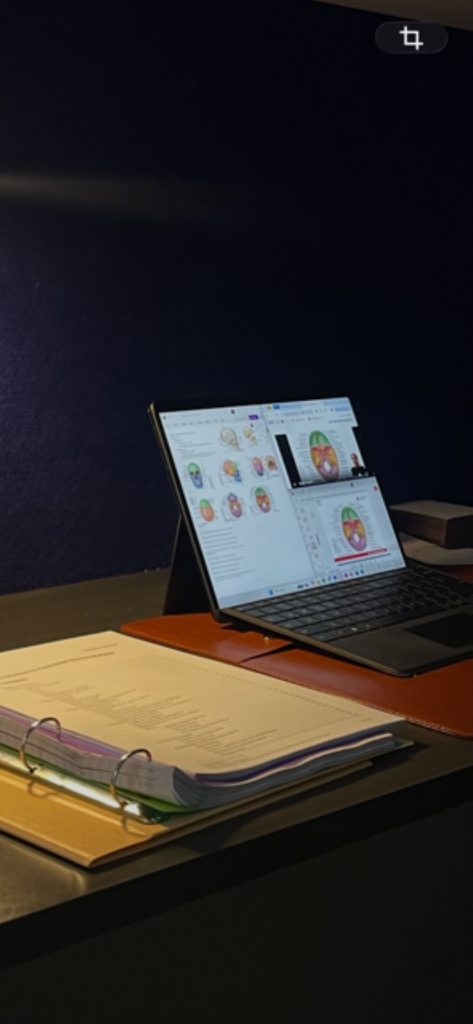
Everyone’s study schedule looks different. I found ChatGPT (I know what you’re thinking, but hang with me!) to be a great tool to help build a routine. You can simply type in your commitments such as classes, work, gym, appointments, social plans and how many study hours you want to achieve. Once you have a baseline template, you can adjust it to suit your routine.
OT is so broad
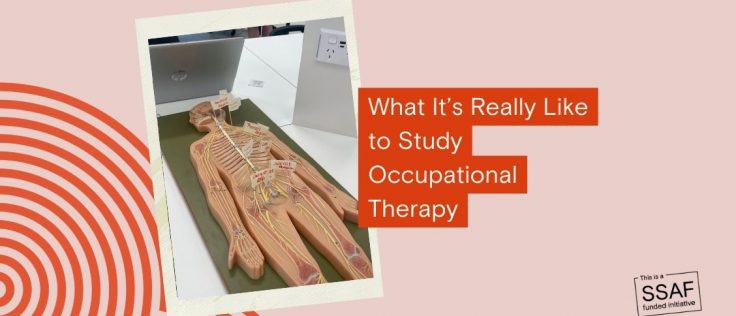
As an OT student, people constantly ask, “What is OT?” and “Is that the same as physio?” As annoying as it can be, I’m beginning to understand why. Occupational Therapy is incredibly broad, even as a student it can be hard to grasp all the possible pathways.
Some areas of OT include mental health, paediatrics, disability, aged care, community, Indigenous Australian health, and acute care. Placement throughout uni is a great opportunity to explore different areas and discover what interests you most.
Learning to think like an OT
Have you ever visited someone’s house and noticed their bathroom layout? Welcome to the life of an OT. The joy of level-access showers and handheld shower heads, and the trauma response of a shower over a bath with no circulation space.
This is the core of learning to think like an OT. You will constantly notice environments, equipment, and behaviours, and think about what someone has, wants, and needs. My favourite part of OT is person-centred care. This means understanding the person as a whole. We look at PEO factors (personal, environmental, and occupational) to guide therapy. It’s incredibly rewarding to provide care based on what truly matters to someone.
Placement in first year
OT students are lucky to experience placement in the first year. This two-week supervised block allows you to work alongside an Occupational Therapist in a real clinical setting. Although it can feel like being thrown in the deep end, it helps solidify your learning and apply concepts in real life.
I remember feeling completely unprepared before placement. But after a few days, I felt reassured in my career choice. I realised this is a career that will challenge me, allow me to connect with people, and help others achieve their highest quality of life. I returned to uni feeling more motivated and excited than ever.
Advice I wish I’d heard before starting OT
It’s okay not to have everything figured out in your first year. Use this time to settle into a routine and find your balance between study, work, and life. Taking care of yourself is essential, ensuring to make time for friends, exercise, rest, and soaking up uni life.
Don’t overcommit to work if it interferes with your studies. There are plenty of flexible student jobs and uni opportunities available.
Say yes to opportunities. Put yourself out there, meet people, and gain experience. Some of my favourite uni experiences have been writing for Charlie, working Orientation, living on campus, and joining clubs.

Give yourself credit for the big step you’ve taken and the huge life adjustment you are going through! Ride out the wave, you are more than capable, you’ve got this!
Charlie blog is a SSAF funded initiative.