
Written by Eva Zengovski
As an online student, I choose to spend all my time studying at home. Although my bookshelf is two metres away from my desk, there was only one book that I picked up during my first year at uni. I felt disappointed in myself for not reading more, so I decided I was going to work on it.
There are lots of students, like me, who don’t have the motivation to read outside of uni. Often, we prefer doing something else in our spare time. But the number of times I chose to do anything but read was just another form of procrastination.
I still find it difficult to get back into reading when I spend most of my time facing a screen. But recently, I noticed that instead of trying to combat this, I could use it as motivation. I realised there were two methods I had been using to bridge this gap, and they both involve digital media.
Create a book logging account
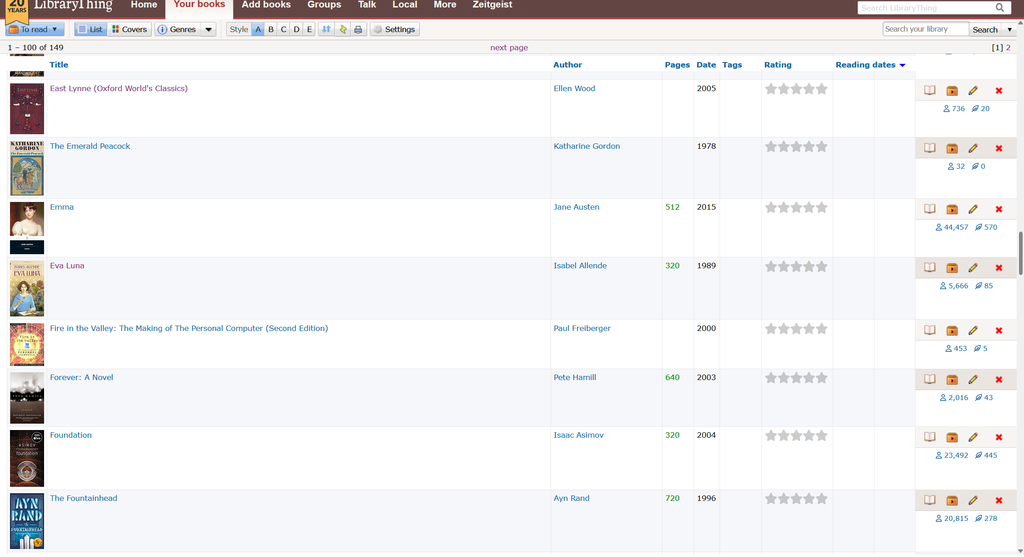
It may seem counterintuitive to use the internet to break away from the internet, but when used correctly, it can be a great way to get back into reading. I sometimes browse LibraryThing, an old book-cataloguing site, during my study breaks. Scrolling through my to-read list when I can’t motivate myself to pick up a book is enough to make me want to do so.
The site has been particularly helpful to me as someone who reads very slowly. Having a set goal for the number of books I want to read in a year gives me a sense of direction. While this method can be done by hand, I’ve found that displaying all the novels I want to read on my phone or computer serves as a daily reminder, as I often have one of these devices near me. I’ve read more books this year than I did last year, and I now know what I want to improve on next year (reading longer books).
Discover books that were adapted into movies
Most people are more likely to watch TV than read a book, but this can be used as an advantage. Think about the last movie you watched, a classic you’ve sat through, or a movie that made you cry. Then, think about whether it was an adaptation. Sometimes, it’s obvious if a movie was based on a novel. Other times, it’s a surprise.
For instance, I had no clue that About a Boy and High Fidelity were based on novels by the English author Nick Hornby. When I discovered this, they were instantly added to my to-read list. The great part about this is that once I finish the books, I get to watch the movies with a whole new perspective.

It can also get you interested in specific forms of literature. Every now and then, I put on a movie released during the Golden Age, and I always expect the opening credits to read “Based on the play by…” This got me interested in finding specific plays, and I realised how much I enjoyed reading them after lectures.

Final Note
While these methods have improved my reading, I haven’t made as much progress as I would like to. Although I am still a slow reader, I now have the motivation to read again. Without motivation, getting back into reading can feel like an almost impossible goal. For that reason, I am glad that these two small strategies have helped me, and I hope they will be of use to you.
Charlie blog is a SSAF initiative.