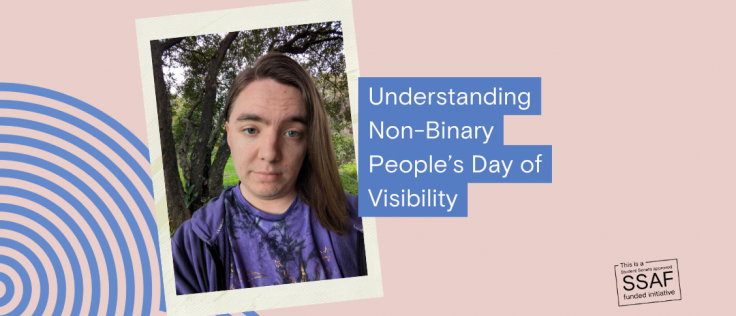
Written by James Watson
Before I get into the question posed by the title, I want to bring attention to the day on which this is posted. July 14 falls halfway between International Men’s Day (November 19) and International Women’s Day (March 8). While the men’s and women’s days get some amount of attention, Non-Binary People’s Day tends to get ignored by most people outside the LGBTQIA+ community (and even plenty within the community). I wanted to rectify that somewhat with a piece about what exactly it means to me and others.

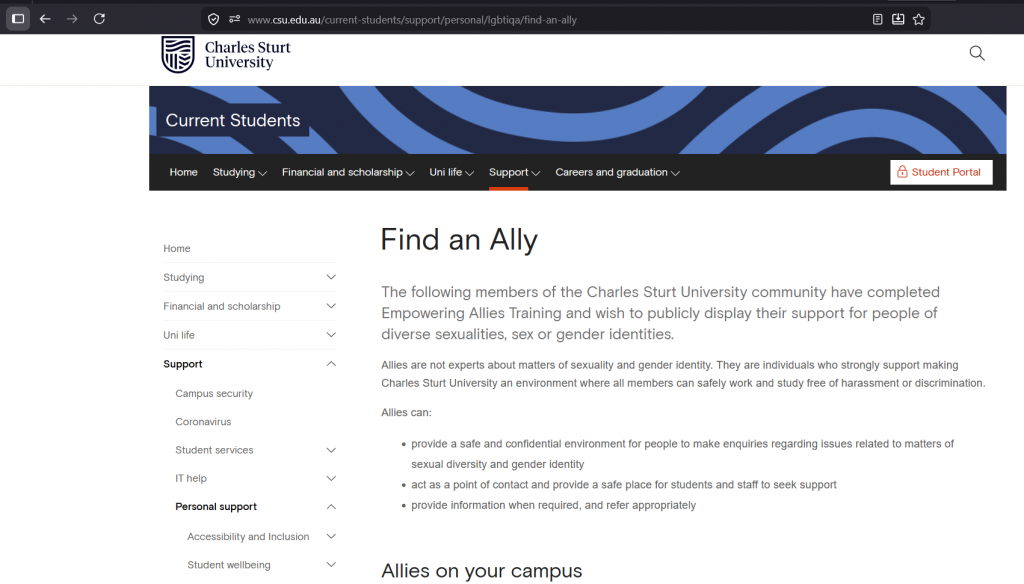
The LGBTIQA+ Ally Network at Charles Sturt is also something that I want to flag to anybody interested in these topics. Whether you are on-campus or online like myself, the continued inclusion, advocacy and visibility provided by what the Network has done and continues to do make the global political scene around this topic a lot easier to bear. If you are interested in learning more, joining and/or contacting the network as a student, please do have a look around https://www.csu.edu.au/current-students/support/personal/lgbtiqa for further information.
Non-binary is, overall, an umbrella term. There are plenty of identities that fit within this category: genderfluid, bigender, agender, demiboy/demigirl and Two-Spirit are a few that spring to mind, but these are beyond the scope of this introductory piece. While there are some correlations between non-binary people as a group, it is important to recognise that such generalisations are not universal.
I personally have required the forging of my own micro-label to feel satisfied that I am getting the right idea across if people ask. In my considered opinion, it is a lot easier to ask for pronouns than to ask about someone’s gender identity—it is both simpler to explain for many queer individuals and easier to understand for those outside the loop. A note to save later confusion: if multiple “options” of pronouns are given (e.g. she/they), that almost always means that every given one is acceptable but the first is the most preferred.
The most important thing to understand about gender is that it is a personal experience. You do not have to be transgender, non-binary, questioning or even aware of the possibilities to have a gender. It is something that is innate to personhood. In another sense, it is one more label we put ourselves and others into. It is worth noting that gender mostly consists of sweeping generalisations, with more variation within these categories than between them.

And here we finally can begin to understand the question. Non-binary is a category, a way of identifying your gender by what it is not. Literally defined, it means being outside of the perceived gender binary of man and woman, but in reality all three of these terms are ever-changing with our world and developing in step with communication technologies and fashion.
Non-binary does not mean that someone is required to be androgynous. I personally find the most enjoyment in making others confused about how to refer to me, and I have a few stories to tell already about these situations, but this is not a rule that others are required to follow to be welcome within this label.
Something that others draw non-binary gender euphoria from is choosing a name that has no gender connotations. I personally am happy with how my name presents, family history and even the masculine assumptions made by most people are no issue for me.
To summarise, non-binary is a generalised umbrella term for people who identify outside the gender binary. Identifying as non-binary can involve such goals as androgyny and changing one’s name, but these are not required.
Charlie blog is a SSAF initiative.