Written by Lewis Donaldson
Artificial Intelligence has quickly become a go-to tool for many of us. Need to summarise a lecture? There’s a tool for that. Struggling with an essay topic? AI can spit out an outline in seconds.
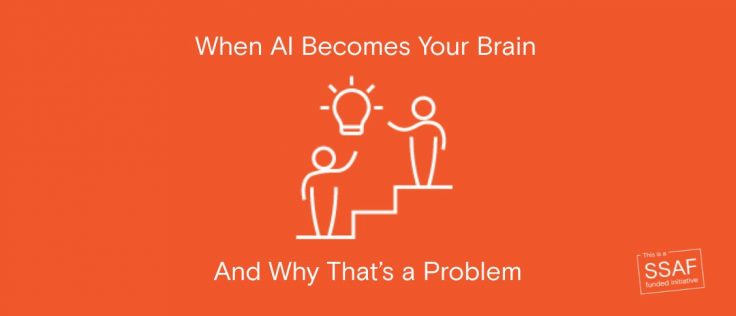
While these tools can save time, there’s a growing concern: the more we rely on AI, the more we risk losing essential skills and habits that higher education is meant to develop.
Declining Critical Thinking Skills
Uni isn’t just about memorising facts – it’s about learning to think critically, evaluate sources and build your own arguments.
When AI delivers ready-made answers, it’s tempting to skip the mental heavy lifting.
Over time, this can dull your ability to analyse problems independently, leaving you less prepared for careers that require complex decision-making.
It’s a similar case to our reliance on GPS. When we offload our navigational thinking to technology, we become disoriented when it fails.
Weakening Research Abilities
Research is a skill you can’t replace with a chatbot. Good research involves digging through academic journals, comparing viewpoints and spotting bias.
Research conducted in 2024 found that an overreliance on AI systems leads students to just accept AI-generated recommendations without question. Evaluation skills – gone.
If we rely solely on AI-generated summaries, we risk missing important parts of the puzzle – or worse, citing information that’s inaccurate or out of context.
Overconfidence in Technology
AI tools often sound confident, but they can still get things wrong. Blind trust in AI means you might accept false information without questioning it.
This is especially risky in fields like medicine, law and engineering where mistakes have real-world consequences.
Creativity on the Decline
Creative thinking comes from wrestling with ideas, making unexpected connections and exploring different perspectives.
If AI is doing the brainstorming, you might find yourself stuck in a cycle of boring, generic ideas instead of actually producing cool, original ones.
Poor Retention and Learning Gaps
Learning is an active process – reading, note-taking, rewriting, discussing. If AI does the work, the brain doesn’t engage in the same way, which means information is less likely to stick.
A 2023 study found a 25% decline in test accuracy of AI users compared to those who didn’t use the technology.
This can lead to knowledge gaps that show up in exams, job interviews and professional situations.
Dependence That’s Hard to Break
The more you rely on AI, the harder it is to function without it.
This creates a dangerous dependency – what happens during an exam or in your job when you don’t have access to the tool?
So what do I do?
AI can be a helpful assistant, but it’s not a substitute for the skills and habits you build at university.
The goal isn’t to avoid AI entirely, but to use it sparingly – like a calculator for complex sums, not basic maths.
It’s a lot easier to put on weight than it is to burn it off. If you indulge in AI all the time, it’s hard to keep your brain fit.
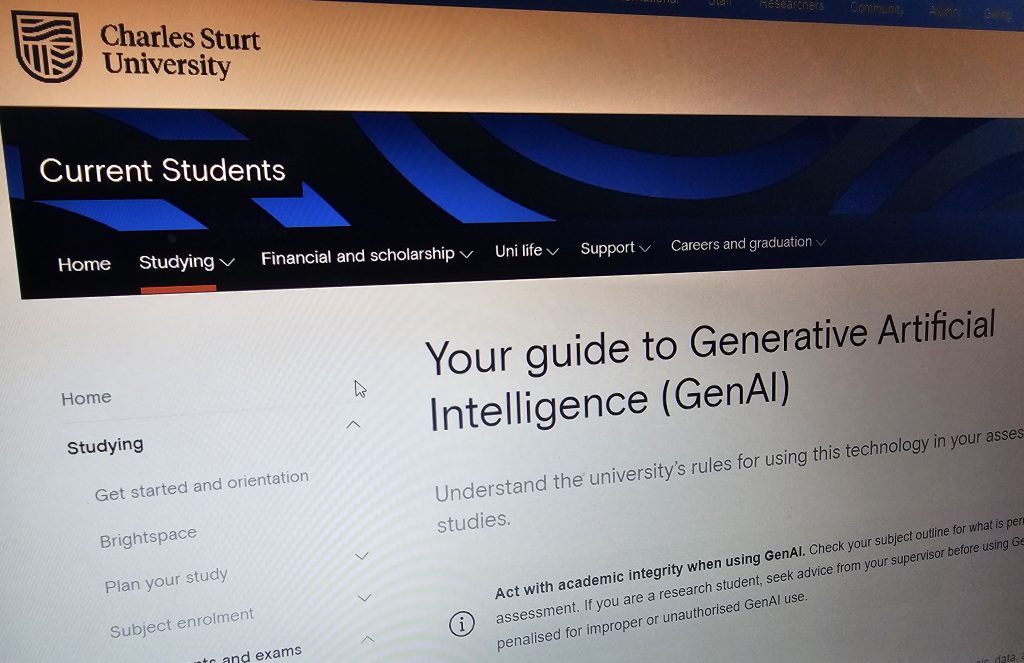
If you’re unsure if you’re allowed to use AI, refer to your subject outline. You can also head to Charles Sturt’s guide on AI.
Charlie blog is a SSAF funded initiative.